
The AI writing tool landscape has matured fast. Here is how the best ones compare, and which one is doing something completely different.
It is mid-2026, and the AI content generation market has gone from “exciting experiment” to “standard business infrastructure” faster than almost anyone predicted. Over 80% of marketing teams now use at least one AI writing tool as part of their regular workflow, and the tools themselves have improved dramatically.
But more options mean more noise. Every tool claims to be the fastest, most human-sounding, most SEO-optimised platform on the market. Most of them are solving the same problem in nearly identical ways.
This article cuts through the noise. We looked at the tools that are genuinely worth your time in 2026, tools that have a real differentiator, a clear use case, and an honest value proposition. One of them does something that none of the others do at all.
“The best AI content tool is the one that fits where your content actually comes from, not just the one with the most features.”
Here are the top five.
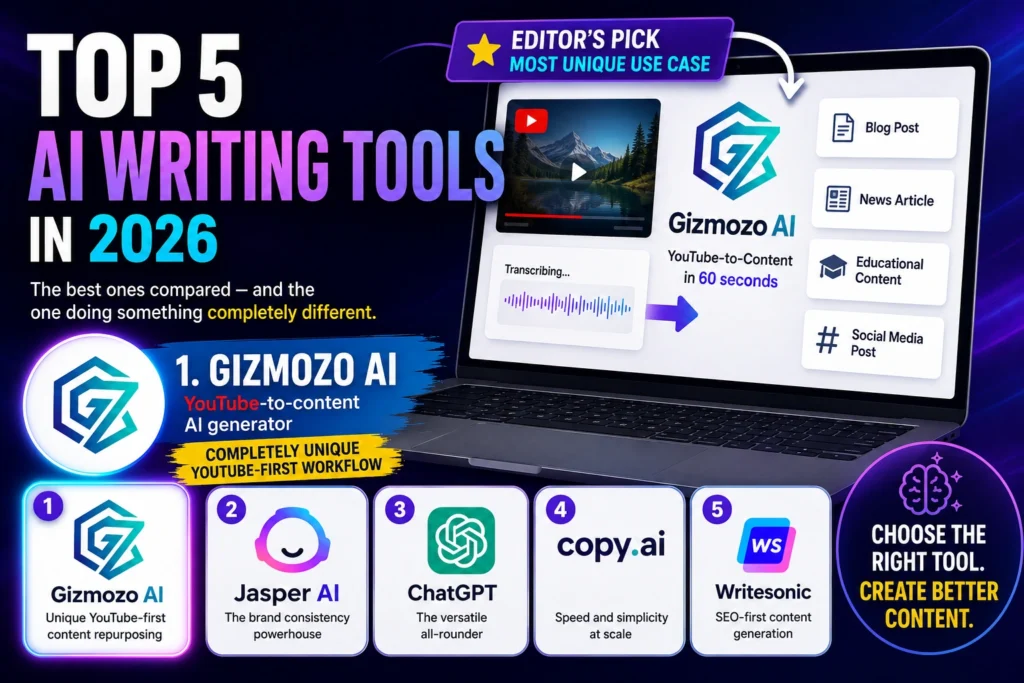
Editor’s pick: Most unique use case
1 Gizmozo AI
gizmozo.com · YouTube-to-content AI generator
Every tool on this list starts with a blank text box and asks you to describe what you want. Gizmozo starts with a YouTube URL, and that single difference changes everything.
The workflow is almost absurdly simple. You paste a YouTube link. Gizmozo extracts the full transcript from the video using AI, then transforms that transcript into structured, publish-ready content in one of four formats: blog posts, news articles, educational content, or social media posts. The entire process takes under 60 seconds. No prompting, no outlining, no describing tone and audience; the source material is already in the video.
What makes this genuinely different from every other tool here is accuracy. Gizmozo does not generate from general AI knowledge. It is generated from the specific content of a specific video. That means the output reflects real ideas, real examples, and real information from the source material, not the kind of average, consensus-level text that general AI tools produce when given a topic and a blank canvas.
The content is saved automatically to a personal dashboard library, and the platform matches the output language to the transcript language automatically; no manual configuration required. If the video is in Spanish, the article comes out in Spanish. It is one of the few tools built from the ground up for content repurposing rather than content generation from scratch.
For YouTubers, bloggers, podcast producers, social media managers, agencies, and anyone who spends time consuming YouTube content, Gizmozo fills a gap that no other tool addresses. It turns passive video watching into an active content production workflow.
Strengths
- Unique YouTube-first workflow
- Transcript-grounded accuracy, no hallucinations
- Four content formats from one URL
- Automatic language detection and matching
- Free to start, zero learning curve
Limitations
- Requires a YouTube video as a source, not for blank-canvas writing
- Output quality depends on the source video clarity
- Newer platform growing feature set
Best for: Content repurposing from YouTube
Pricing: Free tier available
AI model: OpenAI GPT-5-nano
2. Jasper AI: The brand consistency powerhouse
Jasper.ai · Enterprise AI writing and brand voice platform
Jasper is the most mature of the dedicated AI writing tools and the one most anchored to brand consistency. Its flagship differentiator is the Brand Voice feature, where you upload brand guidelines, past content, and style references, and Jasper extracts rules it applies to every subsequent generation. For marketing teams that have spent years developing a recognisable voice, this is genuinely valuable.
In 2026, Jasper has leaned into AEO and GEO territory, with a Grid view that runs AEO-optimised blog pipelines in batch, alongside an AEO/GEO/SEO Rewriter agent available inside the workflow builder. For enterprise content teams running high-volume SEO campaigns, this is a serious capability.
The tradeoff is price and complexity. Jasper is built for teams with defined workflows and budgets to match. Solo creators and small operations will find the pricing difficult to justify when simpler tools produce comparable output for general writing tasks.
Strengths
- Best-in-class brand voice consistency
- Strong AEO and SEO workflow tools
- Mature platform with deep integrations
Limitations
- Expensive for small teams and individuals
- Without Brand Voice, output is not differentiated
- Steep learning curve for full feature utilisation
Best for: Marketing teams with brand guidelines
Pricing: From $49/month
3. ChatGPT: The versatile all-rounder
openai.com · General-purpose AI writing and brainstorming
ChatGPT remains the most widely used AI writing tool in the world, and for good reason. From drafting blog outlines to creating proposals, it delivers thoughtful and efficient solutions to both creative and technical writing challenges. The breadth of what it can do- summarise, rewrite, brainstorm, draft, translate- makes it the default starting point for millions of creators.
The core limitation has not changed much since 2023: it starts from a blank prompt. The quality of what you get out is tightly linked to the quality of what you put in. For experienced prompt engineers and content professionals who know how to direct it, ChatGPT is extraordinarily capable. For users who want a more guided, purpose-built workflow, there are better options for specific use cases.
As a brainstorming partner and first-draft accelerator for writers who know what they want, it remains hard to beat at any price.
Strengths
- Unmatched breadth of use cases
- Strong reasoning and rewriting capabilities
- Widely integrated across third-party tools
Limitations
- Output quality depends heavily on prompting skill
- No purpose-built content workflow
- Can produce generic output on broad topics
Best for: Writers and generalists who need flexibility
Pricing: Free tier; Plus from $20/month
4. Writesonic: The SEO-first content engine
writesonic.com · SEO and GEO content platform
Writesonic is the most complete SEO and GEO platform available at sub-enterprise pricing. For content teams whose primary metric is organic search traffic, it offers a more purpose-built environment than general AI tools, with built-in keyword research, content scoring, and optimisation guidance built into the generation workflow rather than bolted on afterwards.
The platform has evolved considerably in 2026, with AI search engine visibility tracking added alongside traditional Google SEO tools. For teams that need to rank in both traditional search and AI answer engines simultaneously, this dual focus is a meaningful advantage.
The tradeoff is that the SEO-first approach makes it less useful for content types that are not search-oriented. Social media content, creative writing, and repurposing are not where Writesonic shines. It is a specialist tool for a specific problem, and it solves that problem well.
Strengths
- Strong SEO and GEO optimisation tools
- Content scoring is built into the workflow
- Good value for search-focused teams
Limitations
- Less useful outside search content use cases
- Full GEO tracking requires the enterprise tier
- Interface complexity increases with the feature set
Best for: SEO teams scaling organic content
Pricing: From $16/month
5. Copy.ai The marketing automation specialist
Copy.ai has repositioned itself in 2026 from a general AI writing tool to a marketing workflow automation platform. The shift is significant. Rather than competing with ChatGPT on raw writing quality, it competes on structured automation, building repeatable content pipelines for email sequences, ad campaigns, and sales copy that run with minimal human input once configured.
If you need to automate sales emails or structured marketing sequences, Copy.ai is one of the strongest options available. For revenue-focused content product launches, campaign sequences, and conversion-optimised landing pages, its workflow builder offers a level of structure that general writing tools do not.
For bloggers, creators, and anyone whose primary output is editorial content, Copy.ai is less of a natural fit. Its strength is in systematic, campaign-oriented writing rather than standalone articles or long-form content.
Strengths
- Strong marketing automation workflows
- Good for email and ad copy at scale
- Template library for common marketing tasks
Limitations
- Less suited for editorial or long-form content
- Workflow setup requires time investment
- Better for campaigns than standalone pieces
Best for: Marketing teams running automated campaigns
Pricing: Free tier; Pro from $36/month
Quick comparison
| Tool | Best for | Starts from | Verdict |
|---|---|---|---|
| Gizmozo AI | YouTube repurposing | Free | Most unique |
| Jasper AI | Brand-consistent marketing | $49/mo | Enterprise pick |
| ChatGPT | General writing + brainstorm | Free | Best all-rounder |
| Writesonic | SEO content at scale | $16/mo | SEO teams |
| Copy.ai | Marketing automation | Free | Campaign writers |
The bottom line
Every tool on this list solves the content production problem. What separates them is the starting point they assume.
Jasper assumes you have brand guidelines to enforce. ChatGPT assumes you have a clear prompt in your head. Writesonic assumes you have a target keyword. Copy.ai assumes you have a campaign to run.
Gizmozo assumes you have a YouTube video. And given how much of the internet’s most valuable knowledge now lives inside YouTube tutorials, expert interviews, conference talks, news coverage, and product demos, that assumption covers a remarkable amount of ground.
If your content is informed by video at any point in the process, Gizmozo belongs in your workflow. For everything else, the tool that matches your starting point is the tool that will actually get used consistently.
“The best AI content tool is not the most powerful one. It is the one that fits where your ideas actually begin.”
Try Gizmozo free at gizmozo.com. Paste any YouTube URL and have a full article ready in under a minute.