
Every YouTube video you publish is already ten pieces of content waiting to exist. Most creators never unlock them. Here is exactly how to change that and the tool that makes it take minutes, not hours.
You spent six hours producing a YouTube video. You scripted it, filmed it, edited it, optimised the thumbnail, and finally hit publish. It went live on Tuesday. By Thursday, you promoted it once on Instagram and once on LinkedIn. Then you moved on to the next video.
That is how most creators treat their content. And it is one of the most expensive mistakes you can make in content marketing, not because the video was bad, but because the video was only ever used as a video.
The knowledge inside that recording every insight, every example, every framework you explained exists in one place. One URL. One format. Invisible to search engines, unreachable by the people who prefer reading, and gone from social feeds within 48 hours of posting.
Repurposing YouTube content fixes all of that. It is the practice of taking what already exists inside your videos and transforming it into additional formats that reach additional audiences on additional platforms without filming a single new second of footage.
3.2× – faster channel growth for creators who repurpose consistently
78% – of successful creators use a documented repurposing strategy
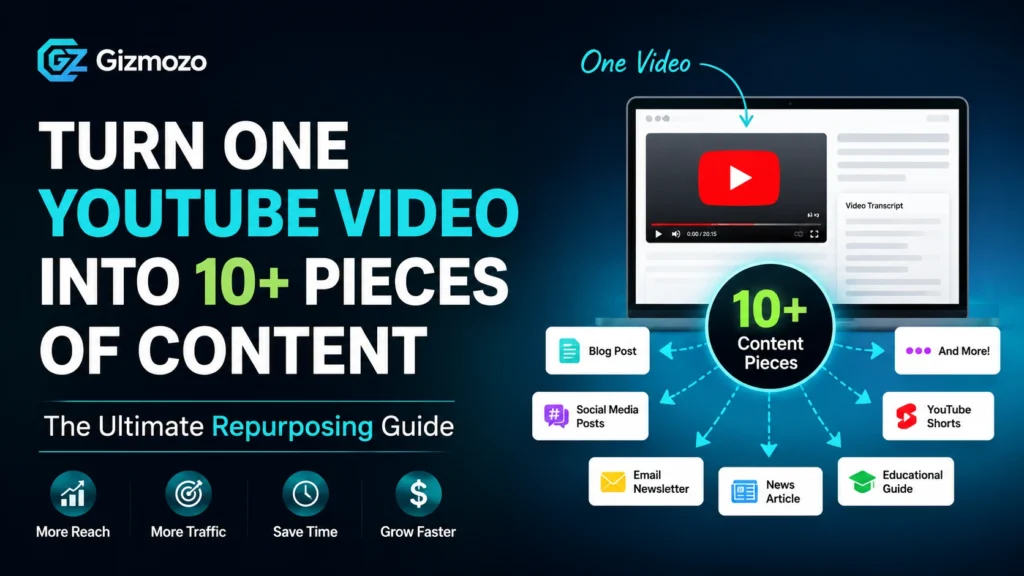
10+ – pieces of content available inside every single YouTube video
Why repurposing YouTube content is the smartest strategy in 2026
The creator economy has a production problem. Audiences expect consistency across multiple platforms simultaneously a YouTube presence, a blog, a LinkedIn voice, a newsletter, an Instagram feed. Building all of those from scratch, in parallel, is an unsustainable amount of work for any individual creator or small team.
Repurposing solves this by inverting the workflow. Instead of asking “what should I create for each platform today?” you ask “what can I create once and distribute everywhere?” The YouTube video becomes the source of truth. Everything else flows from it.
According to Influencer Marketing Hub’s 2026 Creator Economy Report, creators with documented strategies grow 3.2x faster than creators without one, and documented repurposing workflows are among the most common strategies those fast-growing creators share.
The SEO argument alone justifies the effort. YouTube’s own internal data shows that creators posting across multiple formats grow their subscriber base 3x faster than single-format creators. A blog post based on your video creates a searchable, indexable page that can drive consistent organic traffic for years, something a YouTube video URL can never do on its own.
“A YouTube video is not a piece of content. It is a source of content. Most creators never make that distinction.”
The 7 best formats to repurpose your YouTube videos into
Not all repurposing formats are equal. Some drive traffic, build authority, and some grow followers. The best repurposing strategies combine formats that serve different functions. Here are the seven that deliver the most value in 2026.
📝 Long-form blog post The highest-value repurpose. Creates an SEO-indexable page that can rank for years. Every YouTube video should have a companion blog post.
📰 News or analysis article For videos covering industry news, trends, or events. Turns commentary into structured reporting that news-focused readers seek out.
📲Social media post
A single strong insight from the video rewritten as a hook-first social post. Works across Facebook, LinkedIn, Instagram, and X.
🎓Educational guide
Tutorial and how-to videos become structured learning articles. Great for course creators and educators building written resource libraries.
⚡YouTube Shorts or Reels
YouTube Shorts now receive over 90 billion views per day.
Clipping the strongest 60-second moments from long-form videos is the fastest path to new audiences.
✉️ Email newsletter
The video’s key insights become newsletter content. Keeps subscribers engaged between uploads and drives traffic back to the original video.
Which format to prioritise first
Start with the blog post. It has the longest shelf life, the highest SEO value, and creates a permanent searchable home for the video’s ideas. Every other format can be built from it: social posts pull from blog sections, newsletters summarise the article, and educational guides expand on specific points.
The written content problem and how Gizmozo solves it
Creating short-form video clips from a YouTube video is straightforward; tools like OpusClip handle that automatically. Creating social media quote cards is relatively quick. But the written content formats blog posts, news articles, educational guides, newsletters have always been the bottleneck.
The manual process is genuinely painful. You watch the video back, take notes, organise the notes into an outline, write a first draft, edit it, format it. For a 30-minute video, that process takes three to four hours. For a creator publishing weekly, that is three to four hours every single week just for the blog post before touching any other repurposing format.
This is the exact problem Gizmozo AI was built to solve.
A complete weekly repurposing workflow you can follow
The creators who repurpose most effectively do not treat it as a separate project. They establish a simple workflow: for every new video published on Tuesday, they create a specific set of assets by Friday and schedule one blog post for the following Monday. Here is a practical weekly workflow built around that principle.
Day of publish – generate the blog post immediately
As soon as the video goes live, paste the URL into Gizmozo and generate the blog post. Publish it the same day or schedule it for the next morning. The video and article reinforce each other: the article embeds the video, the video links to the article.
Day 1 – generate and post the social media content
Use Gizmozo’s social post format to generate the caption. Post it across your social platforms. The key rule: each post should start a different conversation; do not simply share the video link with a description. Lead with a hook drawn from the video’s strongest insight.
Day 3 – clip the strongest 60-second moment
Use a tool like OpusClip to identify and extract the most compelling segment. Post it to YouTube Shorts, Instagram Reels, and TikTok. This format reaches audiences that will never find the long-form video.
Day 3 – clip the strongest 60-second moment
Use a tool like OpusClip to identify and extract the most compelling segment. Post it to YouTube Shorts, Instagram Reels, and TikTok. This format reaches audiences that will never find the long-form video.
Day 7 – send the newsletter
Use Gizmozo’s blog post output as the basis for your newsletter. Summarise the three key takeaways, link to the full article, and embed the video. Subscribers who missed the upload get a second chance to engage.
Day 14 – re-promote from a different angle
Most people will not see the first post.
Return to the video two weeks later and extract a different insight — a statistic, a counter-intuitive point, a specific example. Each re-promotion starts a new conversation with a different part of your audience.
Time investment reality check
This entire workflow blog post, social post, Shorts clip, and newsletter takes under 45 minutes per video when using Gizmozo for the written content. Without a tool, the same workflow would take 5–6 hours. The difference is the difference between repurposing being sustainable and it being a project you abandon after three weeks.
How to decide which videos to repurpose first
If you have a back-catalog of videos that have never been repurposed, start with the highest performers rather than the most recent uploads.
Use your YouTube Analytics to identify your top-performing videos from the last 6–12 months: the ones with the highest watch time, engagement, or that generated the most subscribers. These already have proven audience interest. A blog post based on a video that earned 50,000 views is far more likely to rank and drive traffic than a blog post based on a video that earned 500 views.
After clearing the high performers, establish the forward workflow: every new video is repurposed during the week of publication, following the five-step process above. The backlog clears over time as you work through it systematically.
Repurposing tools: what each one is best for
| Tool | Best for | Formats | Effort |
|---|---|---|---|
| Gizmozo AI Top pick written content | Blog posts, news articles, educational content, social captions from YouTube URLs | Blog, News, Educational, Social | Paste URL → done |
| OpusClip | Auto-clipping long-form video into Shorts and Reels | Short-form video | Upload → select clips |
| Repurpose.io | Automated cross-platform video distribution | Video cross-posting | Set up once, runs automatically |
| Canva | Quote cards and carousel graphics from video content | Static social graphics | Manual but fast with templates |
| Descript | Editing talking-head and tutorial videos for repurposing | Edited video clips | Medium — requires editing |
Common repurposing mistakes to avoid
Posting the same content identically across platforms
A blog post pasted into LinkedIn as a post does not work. A Twitter thread posted to Facebook reads as noise. Each platform has its own native format, vocabulary, and audience expectation. Repurposing means transforming the content for each destination, not copying and pasting between them. Gizmozo’s social media format produces content written natively for social sharing, not blog excerpts reformatted as captions.
Repurposing everything without auditing first
Not every video deserves the full repurposing workflow. Casual vlogs, behind-the-scenes clips, and low-performing videos are poor candidates for repurposing. Conduct a content audit first, identify your top-performing videos, and prioritise those. Quality of repurposed content matters more than volume.
Promoting once and moving on
One of the most common mistakes creators make is promoting a video once and then forgetting about it. Most people will not see that first post. Treating promotion as a timeline of multiple touchpoints over 30 days, each pulling a different insight from the same video, dramatically increases the total audience reached from a single piece of original content.
Treating repurposed content as less valuable
A well-written blog post based on your YouTube video is not lesser content. It is different content for a different format and a different audience.