
Video to blog post AI converts spoken video content into structured, publish-ready articles by extracting the transcript and using a language model to transform it into written prose. The concept is simple. The execution gap between tools is enormous, and understanding why helps you choose the right one and get far better output.
I have spent the better part of two years building and refining this kind of tool, processing thousands of videos across tutorials, interviews, product walkthroughs, and academic lectures. What follows is not a feature comparison; it is an explanation of what is actually happening inside these tools, where the technology breaks down, and what separates a strong output from one you will spend an hour fixing.
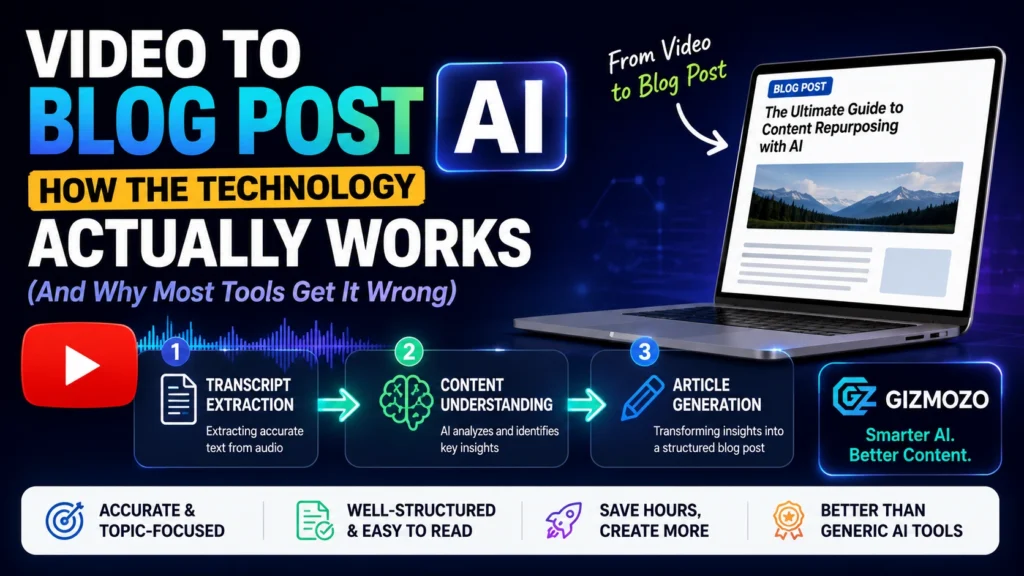
What Video to Blog Post AI Actually Does Under the Hood
Most articles on this topic describe the process at a surface level: paste URL, get article. What they skip is the three-stage pipeline that determines whether the output is genuinely useful or a sophisticated mess.
Stage 1 – Transcript Extraction
Everything starts with the transcript. No matter how good the AI writing layer is, it can only work with what the transcript gives it.
There are two main extraction methods in practice:
YouTube’s auto-generated captions. This is what most tools use, including Gizmozo. YouTube’s speech-to-text has improved dramatically for clearly spoken English content with decent audio; accuracy sits around 95% in typical conditions. The transcript comes back timestamped and structured by paragraph, which gives the next stage useful signal about where topic shifts happen.
Third-party speech-to-text (Whisper, Deepgram, AssemblyAI). Some tools run their own transcription rather than pulling YouTube’s captions. This is more reliable for non-English content and videos without auto-captions enabled, but it adds processing time and cost. For most YouTube content published in the last three years, the auto-caption approach is sufficient.
The non-obvious point here: the transcript is not the article’s source material it is the article’s raw material. A transcript of a 20-minute video is roughly 3,000–4,000 words of unedited, unpunctuated speech. It contains repetitions, asides, incomplete sentences, verbal tics, and ideas that were expressed better later in the video than when they were first introduced. The quality of what the tool does with that raw material is the entire game.
Stage 2 – Content Understanding
This is where tools diverge most sharply, and where the quality differences that matter to a publisher actually come from.
A basic implementation of video to blog post AI sends the transcript to a language model with a prompt like: “Turn this transcript into a blog post.” The model does something reasonable with it, but the output tends to follow the video’s chronological order (including digressions), preserve repeated points, and produce writing that still reads like transcribed speech with better punctuation.
A more sophisticated implementation does several things before generating a word of article text:
- Topic identification – what is this video fundamentally about?
- Audience inference – who was the speaker talking to, and at what knowledge level?
- Key insight extraction – which ideas in the transcript are most valuable and most worth preserving?
- Structure planning – what is the logical order for a written article covering this content, independent of the order it was spoken?
When I was building Gizmozo’s prompt architecture, the single biggest quality jump came from separating the “understand the content” step from the “write the article” step even though both happen within the same AI call. Giving the model explicit internal analysis instructions before asking it to write produces structurally coherent articles. Asking it to write directly from the transcript produces transcription with line breaks.
Stage 3 – Article Generation
With a strong content understanding step in place, the generation phase produces articles that:
- Open with a proper introduction that frames the topic’s relevance rather than jumping straight into the video’s first point
- Organise information by logical importance, not chronological order
- Consolidate repeated ideas into single, well-expressed statements
- Remove speech artifacts entirely: no “um,” “you know,” “like I was saying”
- Close with a natural conclusion that reflects the content, not a generic “In summary…” paragraph
The output from a well-designed system reads like it was written. The output from a poorly designed system reads like it was recorded and then cleaned up. A smart reader notices the difference immediately.
The Output Quality Problem Nobody Talks About
Here is the non-obvious insight that most articles in this space skip entirely: generic AI writing and transcript-grounded AI writing produce fundamentally different types of content – and they are not interchangeable.
When you give a general AI model a topic and ask it to write a blog post, it generates from its training data. The result is competent, average, and representative of the general consensus on that topic. It sounds like what “most people say” about the subject because it is synthesised from what most people have written.
When you give a transcript-grounded AI tool the same topic via a specific video, it generates from the specific ideas, examples, and frameworks in that video. The output reflects what that particular person said – their specific angle, their particular examples, their individual take. That specificity is what makes content interesting and citeable.
In practice, this distinction matters most for:
- Tutorial and how-to content – the specific steps a presenter walks through are genuinely unique. Generic AI would give you the standard steps; transcript-grounded AI gives you that presenter’s steps, which may be meaningfully different.
- Interview and opinion content – a person’s specific point of view only exists in the transcript. Generic AI cannot reproduce it accurately.
- News and commentary – specific claims, data points, and arguments from the video need to survive into the article accurately. Generic AI will approximate; grounded AI will reflect.
This is why, when I run a technical tutorial through Gizmozo, the output references the presenter’s actual framework and their specific examples – not the generic version of whatever the video was about. For publishing purposes, that difference is the difference between original content and commodity content.
How Video to Blog Post AI Handles Different Content Types
Not all videos produce equally strong articles, and understanding the patterns helps you pick better source material.
Tutorials and How-To Videos
Strongest output category. The structure maps cleanly from spoken to written — numbered steps, clear progression, defined end state. In practice, a well-produced tutorial video of 15+ minutes consistently produces a 900–1,400 word article that needs minimal editing.
What to watch for: Visual demonstrations (“click here,” “as you can see”) that make no sense in text. A good tool strips these; a basic tool leaves them in.
Interviews and Expert Conversations
Strong, with caveats. The value is in the interviewee’s specific insights, which are genuinely unique. The challenge is that the conversation format is non-linear; ideas come up, get dropped, return, and repeat. A strong AI layer reorganises this into a logical essay. A weak one produces a conversation transcript with paragraph breaks.
In practice: The best interview-to-article outputs read like a reported piece; the ideas are present and accurate, but the conversational back-and-forth is structured into a readable narrative.
Educational Lectures
Good for depth, requires review. Academic and educational content tends to be dense and technically precise. The AI output is typically comprehensive, but technical terms occasionally get misrepresented when auto-captioning struggles with domain-specific language. Always verify technical terminology in this category before publishing.
News and Commentary Videos
Strong when the source is clear. Opinion and commentary videos produce good analytical articles. News event coverage works well when the presenter is clearly describing events rather than reacting to clips shown on screen (which the AI has no access to). Frame the output as analysis, not primary news reporting.
A Practical Framework: Getting the Best Output from Video to Blog Post AI
Based on processing thousands of videos, here is the checklist I would give anyone starting with this workflow:
Before you paste the URL:
- [ ] Choose videos that are at least 10 minutes long; richer source material produces better articles
- [ ] Avoid videos with background music, heavy echo, or poor microphone quality; transcript accuracy drops significantly
- [ ] Prefer videos where the speaker addresses the camera/audience directly over videos where they react to things on screen
When you generate:
- [ ] Select the content type that matches the video (tutorial, educational, news, or general blog post); the structural prompt changes significantly between them
- [ ] For multilingual content, verify the tool outputs in the transcript language rather than defaulting to English
After you receive the output:
- Read it once through before editing – identify structural issues first, then prose issues
- Add 2–3 paragraphs of your own perspective or updated information – this is what makes the content yours and not replicable by anyone with the same URL
- [Embed the original video near the top – it helps readers, and it creates a natural content connection between the article and the video
- Check any technical terminology, statistics, or specific claims against the source before publishing
How Gizmozo Implements This Pipeline
Gizmozo processes each video through all three stages described above extraction, content understanding, and structured generation using content-type-specific prompts that have been refined across thousands of test videos.
The key design decision was building separate prompt architectures for each content type rather than using a single generic writing prompt. A tutorial video and an interview video require fundamentally different article structures. Applying the same prompt to both produces mediocre results for both. Building distinct prompts for each produces strong results for each.
The platform also auto-saves every generated article to a personal content dashboard, which solves a workflow problem that sounds minor but matters in practice: coming back to edit an article three hours after you generated it without having to regenerate it.
Four output formats are supported from a single YouTube URL: blog post, news article, educational content, and social media post, each with its own structural logic and purpose.
FAQ
A raw YouTube transcript is unedited speech unpunctuated, repetitive, full of filler words, and structured chronologically rather than logically. Video to blog post AI transforms the transcript into written prose: restructuring information, removing artifacts, writing a proper introduction and conclusion, and producing an article that reads as if it was written rather than transcribed. The difference in output readability is significant in practice.
It depends on the tool. Gizmozo automatically detects the transcript language and writes the output in that same language, so a Spanish-language tutorial produces a Spanish-language article without any manual configuration. Tools that rely on English-only language models will default to English regardless of the source video language.
For transcript-grounded tools like Gizmozo, the content is as accurate as the transcript, which for clearly spoken content is typically 95%+ accurate. The risk is with domain-specific terminology that auto-captioning occasionally misrepresents. For technical content, always verify specific claims, names, and statistics before publishing.
Based on typical results, a 20-minute video with a competent speaker generates an article of approximately 1,200–1,800 words. The relationship between video length and article length is not linear; a 40-minute tutorial does not produce a 3,000-word article. The AI naturally consolidates repetition and cuts tangents, so the article is almost always significantly shorter than a word-for-word transcript would suggest.
The Bottom Line
Video to blog post AI works, but the gap between a tool that produces publish-ready output and one that produces a cleanup project is explained almost entirely by the quality of what happens between transcript extraction and article generation.
The tools that get this right treat the transcript as source material to be transformed, not text to be reformatted. They understand the content before generating from it. They adapt structure to content type. And they stay grounded in what the video actually said rather than supplementing with generic AI knowledge.
If you want to try a tool built around these principles and get your first article in under 60 seconds, try Gizmozo free at gizmozo.com. Paste any YouTube URL and see the difference grounded generation makes.