
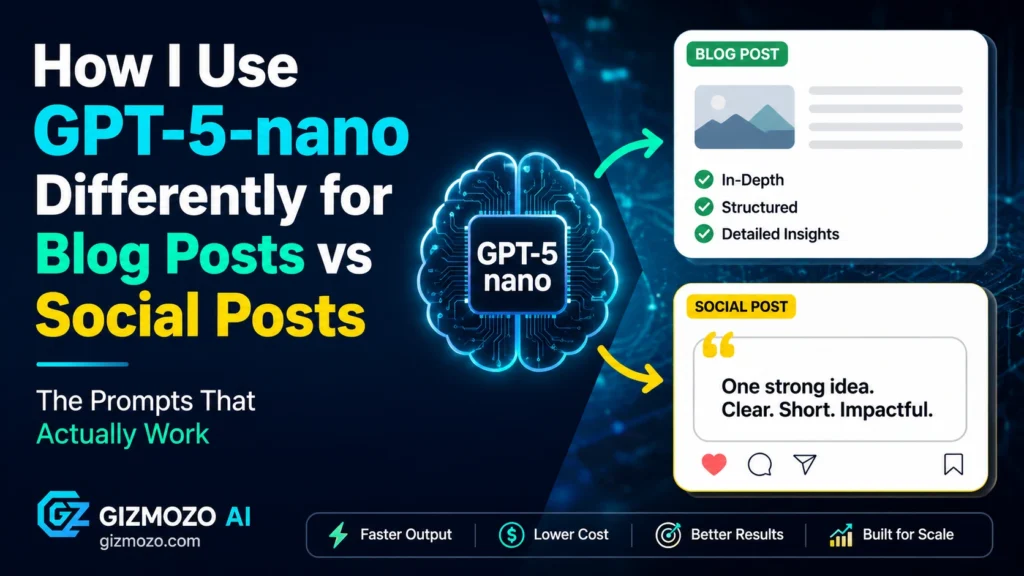
GPT-5-nano is OpenAI’s fastest, most cost-efficient model in the GPT-5 family, and how you prompt it determines almost everything about the quality of what comes back. For content generation, the difference in output between a blog post prompt and a social media post prompt is significant enough that treating them the same is one of the most common mistakes I see builders make.
I run Gizmozo AI, a YouTube-to-content platform that uses GPT-5-nano to transform video transcripts into publish-ready articles, news pieces, educational content, and social posts. We chose GPT-5-nano specifically for its instruction-following precision, low latency, and cost efficiency at scale, and for producing structurally strong output when the prompt architecture is designed for the content type rather than applied generically. Here is what I have learned about using it differently for different formats.
What GPT-5-nano Actually Is and Why It Suits Content Generation
Before getting into the prompt differences, it helps to understand what GPT-5-nano is optimised for. GPT-5-nano is OpenAI’s fastest, cheapest variant of GPT-5. It is designed for tasks where speed and cost matter most: classification, data extraction, summarisation, and high-volume structured output.
The model carries a 400K token context window, supports vision and tool use, and is priced at $0.05 per million input tokens and $0.40 per million output tokens, making it one of the most cost-effective options available for production-scale content workflows.
What that means in practice for content generation: GPT-5-nano follows structured instructions extremely reliably. It does not hallucinate as aggressively as smaller models. It handles long transcripts without losing coherence. And it generates quickly enough that a 2,500-word blog post comes back in under 10 seconds in most cases.
Where it has limits: it is not a deep reasoning model. Complex multi-step analysis, nuanced editorial judgment, or highly specialised domain expertise require a larger model. For the core task of transforming a transcript into a well-structured written article or a social media post, it is precisely sufficient, and the speed and cost advantages are meaningful at scale.
The Non-Obvious Difference: Structure Before Content
Here is the insight that took me the longest to land on, and that most articles about GPT-5-nano for content skip entirely: the structural instruction is more important than the content instruction.
When I first built Gizmozo’s content generation pipeline, I wrote prompts that focused heavily on what the output should contain: cover the main topic, include examples, be engaging, write in a human voice. The outputs were technically correct but structurally mediocre. Blog posts opened awkwardly. Social posts buried the hook.
The shift that changed output quality was leading every prompt with explicit structural instructions, not just what to write, but what to produce first, second, and third. GPT-5-nano follows sequential structural instructions far more reliably than it follows abstract quality descriptors. “Write engagingly” produces variable results. “Open with the single most surprising point in the transcript, then follow with three supporting observations in short paragraphs” produces consistent results.
This applies differently to blogs and social posts in ways worth spelling out.
GPT-5-nano for Blog Posts: What the Prompt Architecture Looks Like
A blog post from a YouTube transcript needs to do several things that a transcript cannot naturally do on its own: establish a proper introduction, reorganise spoken content into a logical written flow, remove verbal repetition, and close with a meaningful conclusion.
The prompt architecture I use with GPT-5-nano for blog post generation in Gizmozo AI has three layers:
Layer 1: Internal Analysis (silent step)
The model is instructed to silently identify the main topic, the audience level, the most valuable insights, and the best structural approach before generating any article text. This step does not produce visible output; it primes the model’s generation context. In practice, this dramatically reduces the chance of the article following the video’s chronological order (which includes tangents and repeated points) rather than a logical written structure.
Layer 2 Structural Directive
The model receives explicit instruction about what each section of the article should accomplish:
- The title goes inside
<h1></h1>tags so Gizmozo’s frontend can parse and place it correctly - The opening paragraph frames the topic’s relevance before introducing any specific detail
- Subheadings are used where they genuinely improve navigation, not on a fixed schedule
- The conclusion reflects the actual content rather than adding a generic summary
Layer 3 Quality and Tone Rails
This layer covers what the model should never do: reference the transcript or video directly, carry speech artifacts into the prose, copy or closely paraphrase source text, or insert filler where a thought is complete. These negative constraints work better with GPT-5-nano than positive quality descriptors in most cases; the model responds to “do not do X” more reliably than “make it feel human.”
The result, in practice: blog posts from 20-minute tutorials come back in the 1,200–1,800 word range, well-structured, readable, and grounded in the actual content of the video rather than generic AI text on the same topic. Light review, a few personal paragraphs added, and they are publishable.
GPT-5-nano for Social Media Posts: A Different Problem Entirely
Social media posts are a completely different generation problem, and the prompt architecture reflects that.
A blog post rewards depth, structure, and progressive development of an idea. A social post rewards immediate impact, brevity, and a single strong hook that makes someone stop scrolling. These are almost opposing requirements, and sending the same prompt for both is what produces social posts that read like condensed blog posts and blog posts that feel like padded tweets.
What the Social Post Prompt Prioritises Differently
Single angle extraction over comprehensive coverage. For a blog post, the goal is to represent the full content of the video faithfully. For a social post, the goal is to find the single most shareable, surprising, or resonant point in the video and build the entire post around that one thing. The prompt explicitly instructs GPT-5-nano to identify this angle before writing anything.
Hook-first structure. The model is instructed that the first line must do the entire job of stopping a scroll and that the first line is not the topic sentence, not the context, not the setup. It is the most arresting thing the post contains. In practice, I tell the model: the first sentence is the only sentence most readers will see. If it does not earn the next sentence, the post has already failed.
Short paragraph discipline. Blog posts can sustain paragraphs of four to six sentences where the idea requires it. Social posts cannot. The prompt caps paragraph length at two to three lines and instructs the model to break aggressively; white space is readability on mobile screens.
Engagement close. Blog posts end with a conclusion or a CTA. Social posts end with a question or a reflection that invites a response. This is not optional for algorithmic performance across any major platform; posts that generate comments are distributed more widely than posts that are read and scrolled past.
Universal platform design. Rather than writing separate LinkedIn, Instagram, and X versions, the social post prompt produces a single 150–300-word post designed to work across all platforms. The structural constraints hook, short paragraphs, engagement close apply universally. Platform-specific tweaks (hashtag count, formatting) are minimal adjustments a user can make in thirty seconds.
Why Gizmozo AI Uses GPT-5-nano Instead of Larger Models
The honest answer is cost and speed at scale, without meaningful quality sacrifice for this specific use case.
GPT-5-nano’s instruction-following reliability is strong enough for structured content generation when the prompt architecture is well-designed. At $0.05 per million input tokens, it is cheaper than 73% of comparable models, which matters when you are processing thousands of transcripts. A larger model would improve output quality marginally on the most complex, nuanced content. For the core task of transforming a YouTube transcript into a structured, accurate, publish-ready article, the marginal quality improvement does not justify the cost multiplier.
The 400K context window is a genuine practical advantage. Long videos 45-minute interviews, hour-long lectures produce transcripts that smaller-context models have to chunk and stitch. GPT-5-nano processes them as a single coherent input, which produces structurally consistent output across the full length of the content.
The speed advantage is also real. Users expect near-instant generation. A 10-second wait is acceptable. A 45-second wait kills the workflow. GPT-5-nano’s latency profile makes the product feel fast rather than like a batch processing tool.
A Practical Framework: Prompting GPT-5-nano for Content Generation
Whether you are building your own pipeline or adapting these principles, here is the checklist that consistently produces stronger output:
For blog posts:
Separate the analysis step from the generation step; give the model a silent internal reasoning pass before it writes
Lead with the title format requirement (H1 tags, or whatever your system expects) before any content instruction
Specify structure by outcome (“the opening paragraph should frame why this topic matters”) not by format (“write a 150-word intro”)
Use negative constraints for quality “do not reference the transcript,” “do not reproduce spoken filler” rather than abstract positive instructions
Specify word count as a range tied to content depth, not a fixed number
For social posts:
Instruct the model to identify the single strongest angle before writing anything
Make the first-line requirement explicit and non-negotiable; it is the hook, not the setup
Cap paragraph length in the instruction, not just in the description
Require an engagement trigger at the close: a question, not a statement
Keep the output to 150–300 words and do not allow padding to fill a longer target
FAQ
GPT-5-nano is best used for high-volume, speed-sensitive tasks where instruction-following reliability matters more than deep reasoning, classification, summarisation, structured content generation, and data extraction. For content pipelines processing hundreds of documents per day, it offers the best balance of output quality and cost in the GPT-5 family.
In most cases, yes, when the prompt architecture is well-designed. The model follows structural instructions reliably, which means well-structured prompts produce well-structured output. The ceiling is lower than larger GPT-5 variants for nuanced creative or editorial work, but for structured content generation from defined source material (like a transcript), the quality is strong enough for professional publishing with light review.
Gizmozo AI uses GPT-5-nano to transform YouTube video transcripts into four content types: blog posts, news articles, educational content, and social media posts. Each content type uses a separate prompt architecture with different structural instructions, quality rails, and output requirements. The model receives the full transcript as source material and generates content grounded in the video’s actual ideas rather than generic AI knowledge on the topic.
Yes. Gizmozo’s prompt architecture instructs the model to detect the transcript language and write the output in the same language, so a Spanish-language tutorial produces a Spanish-language article without any manual configuration. In practice, output quality is strong for major languages and variable for lower-resource languages, which is consistent with the model’s training data distribution.
The Bottom Line
GPT-5-nano is a genuinely capable content generation model when the prompt is designed for the specific output type rather than applied generically. The blog post prompt and the social post prompt are different documents not because the model needs different information, but because the structural logic of a long-form article and a 200-word social caption are nearly opposite.
Getting this right is the difference between a content pipeline that produces usable output and one that produces things you spend more time editing than it would have taken to write from scratch.
Gizmozo AI handles this for YouTube content automatically. Paste any YouTube URL and receive a blog post, news article, educational guide, or social post, each generated with the format-appropriate prompt architecture in under 60 seconds.