
Blogs still matter in 2026 but not for the same reasons they mattered in 2019, and not if you are still publishing the same kind of content.
The traffic model has changed. The citation model has grown. And the blogs that are winning right now look fundamentally different from the ones that are struggling.
Here is what the data actually shows, what it means for content strategy, and the non-obvious reason why blogs may be more valuable in the AI era than they were before it.
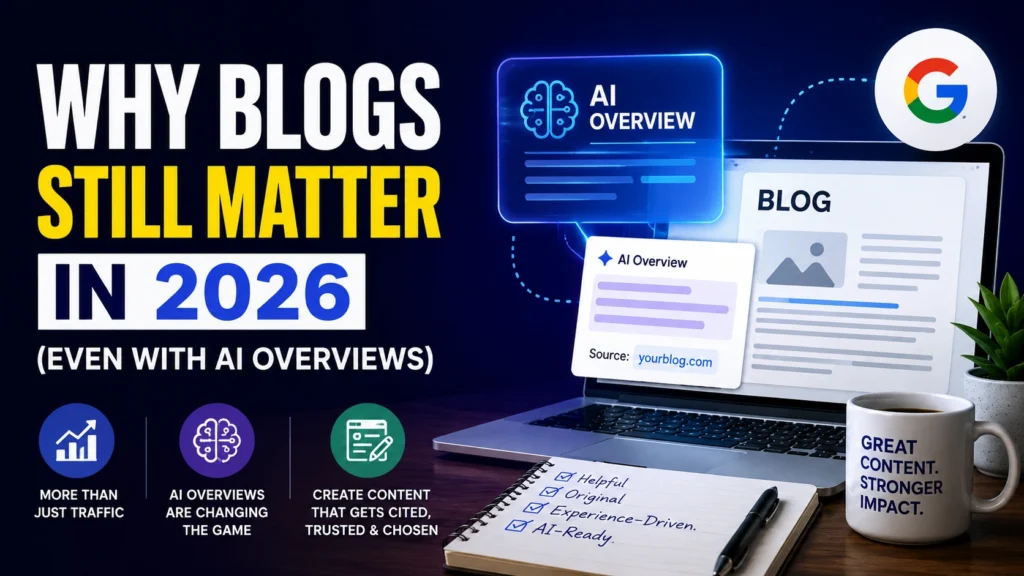
The Traffic Decline Is Real, But It Is Being Misread
Let us start with the honest part. Organic click volume on informational blog content is falling, and the data is not ambiguous.
A July 2025 Pew Research study found that users clicked a traditional organic result only 8% of the time when a Google AI Overview was present, compared to 15% when it was not.
In a 21.9-million-search study, 25.11% of Google searches triggered an AI Overview in Q1 2026 up sharply from 7.64% in February 2025.
If you run a blog that built its traffic on broad informational queries “what is,” “how to,” and “definition of” some of that traffic is not coming back.
But here is where most of the discussion around this topic breaks down:
A drop in blog traffic is not the same as a drop in blog value.
A drop in informational blog traffic can look scary in GA4. But if your leads, calls, local visibility, branded searches, and high-intent page performance are steady, your SEO may still be doing its job.
The measurement frameworks most teams use were built for a different SERP. They track clicks, sessions, and rankings, and they miss an entire class of value that blogs now generate.
What Blogs Are Actually Generating in 2026 That Analytics Cannot See
When your blog post gets cited inside a Google AI Overview, something happens that does not necessarily show up in Google Search Console as a click.
Your brand appears in front of a reader who was looking for exactly what you cover.
That touchpoint has real commercial value. It can shape purchase consideration, build familiarity, and, in some cases, send the user further down the funnel through a completely different channel.
That could be:
- A direct website visit
- A branded Google search
- A referral
- A social media search
- A future product search
This is the measurement gap that is distorting the “are blogs worth it?” conversation.
Sites that measure success only by total sessions will read the 2026 data as a decline.
Sites that weigh conversions and brand visibility may read the same data as a rebalancing.
Why Blogs Still Matter: The Case That Surface-Level Articles Miss
Here is the non-obvious insight:
AI Overviews did not replace blogs. They changed who gets cited in them, and that is a competition blogs can win.
Research suggests that 76.1% of URLs cited in AI Overviews also rank in Google’s top 10 search results.
A page at position one has a much higher chance of being cited in an AI Overview. As rankings fall, the probability of citation also drops significantly.
This means blogs that already rank well can be pulled into AI-generated answers, not simply excluded by them.
The AI Overview is not always a wall between the reader and your content.
For well-ranking, well-structured blogs, it can become a second distribution channel.
The implication is important: if you stop publishing and updating useful content, your search visibility can decline, and your opportunity to appear in AI-generated answers may decline with it.
Blogging is not simply competing against AI Overviews. Good blogging can help earn placement inside AI-generated answers.
Websites with active blogs also create significantly more indexable pages and expand their potential search visibility.
The outcomes of blogging have not disappeared in 2026.
They have shifted from raw traffic toward qualified traffic, brand recognition, topical authority, and AI citation opportunities.
What Kind of Blog Content Still Works in 2026?
The blogs losing traffic are often publishing a specific type of content.
The blogs holding or growing their visibility are publishing something different.
The gap between them is not always luck.
It is content design.
Content That Is Losing Ground
Thin informational posts
Articles that answer one simple question in 400 words are increasingly vulnerable. AI Overviews and other AI search experiences can often answer these questions directly.
Generic how-to content
A tutorial with no original perspective, first-hand experience, screenshots, testing, or specific examples provides little additional value.
This content was already weak.
AI has simply made that weakness more visible.
Volume-over-depth publishing
Publishing hundreds of articles purely to cover keywords is becoming less effective.
Thin AI-generated content with no meaningful human perspective, original value, or editorial input is unlikely to build sustainable search authority.
Content That Is Holding and Growing
Experience-Driven Content
Include specific scenarios, real examples, experiments, screenshots, and first-person observations.
These are things generic AI-generated summaries cannot easily reproduce.
If you tested a tool, explain what happened.
If you used a strategy, show the result.
If something failed, explain why.
Experience is becoming a content advantage.
Original Research and Proprietary Data
Original data is extremely valuable in the AI search era.
Surveys, internal statistics, case studies, experiments, and industry observations give other websites and AI systems something unique to reference.
Data that exists only on your website cannot simply be replaced by another generic article.
Comparison and Decision-Intent Content
Comparison and decision-focused content continues to have strong value.
Examples include:
- Tool A vs Tool B
- Best software for a specific use case
- Is a product worth buying?
- Free vs paid plans
- Alternatives to a popular tool
- Which option is better for beginners?
A reader making a decision needs more than a two-sentence summary.
They need depth, specificity, evidence, and a trustworthy perspective.
Expert-Authored Content With Clear E-E-A-T Signals
Content should demonstrate:
- Experience
- Expertise
- Author identity
- Reliable sources
- Original observations
- Clear subject knowledge
Use a named author.
Create a real author bio.
Explain the author’s experience with the topic.
Cite credible research when making statistical claims.
Poor trust signals can make it harder for both readers and search systems to understand why your content should be trusted.
The AI Citation Opportunity Most Bloggers Are Missing
Imagine a B2B SaaS company generating 80,000 monthly organic sessions primarily through how-to and educational blog content.
Organic sessions decline by 31%.
The immediate reaction might be:
“Our SEO strategy is failing.”
But the rankings remain relatively stable.
The problem is that users are receiving more information directly on the search results page.
Instead of rebuilding the entire keyword strategy, the company audits its existing content.
It discovers that several articles are being used or referenced in AI-generated search experiences, but the brand is not receiving strong visibility.
Why?
The articles lack:
- Clear author signals
- Structured answer blocks
- Company attribution
- Concise opening answers
- Strong content structure
The company restructures those articles.
It adds Quick Answer sections, clearer authorship, better structured content, and stronger brand attribution.
The goal is no longer simply:
“Get more clicks.”
The new goal becomes:
“Become a source search engines and AI systems can clearly understand, trust, and reference.”
This is the adaptation that matters in the AI search era, and many small and mid-sized blogs are still not doing it deliberately.
A Practical Framework: How to Make Your Blog Work in 2026
These are structural changes you can apply to every article you publish or update.
1. Lead With a Direct Answer
Answer the primary question in the first two or three sentences.
Do not spend 500 words introducing the topic.
If the article is titled:
“Are Blogs Still Worth It in 2026?”
Your opening should immediately answer:
Yes. Blogs are still worth publishing in 2026, but their value is shifting from pure organic clicks toward authority, AI citations, brand visibility, and high-intent search traffic.
Answer first.
Explain second.
2. Use Clear H2 and H3 Headings
Use descriptive headings that clearly explain what each section answers.
Instead of:
“The Big Change”
Use:
“How AI Overviews Changed Blog Traffic”
Instead of:
“What Works”
Use:
“What Type of Blog Content Still Ranks in 2026?”
Clear headings help readers scan your content.
They also make the structure of the article easier for search and AI systems to interpret.
3. Include a Named Author
Anonymous posts are at a disadvantage when building trust.
Include:
- Author name
- Author photograph
- Short biography
- Relevant experience
- Author profile page
If someone has worked in digital marketing for 10 years, say it.
If they personally tested the product being reviewed, explain that.
Give readers a reason to trust the person behind the content.
4. Add an FAQ Section
Add two to five genuinely useful questions related to the main topic.
Good FAQ questions often come from:
- Google People Also Ask
- Search Console queries
- Customer support questions
- Reddit discussions
- YouTube comments
- Social media comments
Do not create FAQs simply to add more keywords.
Answer questions real people are asking.
5. Cite Your Claims
If you mention a statistic, link to the original research whenever possible.
Compare these two statements:
“AI Overviews are reducing clicks.”
And:
“A Pew Research study found that users were less likely to click traditional search results when an AI Overview appeared.”
The second statement is stronger because readers can understand where the claim came from.
Reliable sourcing also strengthens the overall credibility of your article.
6. Publish Less, Publish Deeper
One strong article can be more valuable than ten generic posts.
A strong article may include:
- Original screenshots
- First-hand experience
- Expert quotes
- Data
- Comparisons
- Examples
- FAQs
- Step-by-step explanations
- Clear conclusions
The goal is not to reach a specific word count.
The goal is to create the best available resource for the reader’s specific problem.
How Content Repurposing Extends Blog Value Across Channels
One pattern is becoming increasingly important in 2026:
Successful content teams treat a blog post as the beginning of a distribution strategy not the end of a publishing task.
A well-researched blog post can become:
- The source material for a YouTube video
- A LinkedIn post
- A Facebook post
- A social media thread
- A newsletter issue
- A carousel
- A short-form video script
- An AI search citation
This is content multiplication.
Instead of creating eight completely different pieces of content, you create one strong source and adapt it for different platforms.
The reverse is also true.
YouTube videos are an excellent source of blog content.
A tutorial, interview, podcast, product review, or educational video may contain thousands of words of useful information.
But search engines primarily experience that knowledge as video content.
Transforming the video’s ideas into a structured article creates another discoverable content asset.
The video provides the knowledge.
The blog provides an indexable, structured format.
Turn YouTube Videos Into Blog Posts With Gizmozo AI
This is exactly the workflow Gizmozo AI is built to accelerate.
Instead of manually watching a YouTube video, taking notes, organising the information, and writing an article from scratch, you can paste the YouTube URL into Gizmozo AI.
Gizmozo extracts the video’s transcript and transforms the content into a structured blog post in under 60 seconds.
That means one YouTube video can become content that:
- Search engines can index
- AI search systems can understand
- Readers can scan and share
- Bloggers can edit and expand
- Businesses can repurpose across multiple channels
The goal is not to replace human expertise.
The goal is to remove the repetitive work between video and publishable content.
Frequently Asked Questions
Are blogs still worth starting in 2026?
Yes but the strategy has to be right from the start.
Generic, high-volume content that answers simple questions is one of the categories most affected by AI Overviews.
Authoritative, experience-driven content focused on specific topics is more durable because readers and AI systems need reliable sources to reference.
Starting a blog in 2026 with a depth-first, citation-focused approach can create a stronger foundation than relying on an old keyword-volume strategy.
Does blogging still help with SEO in the AI era?
Yes.
However, the mechanism is changing.
A strong blog can help a website build topical authority, rank for relevant searches, earn backlinks, attract high-intent visitors, and potentially appear as a source in AI-generated search experiences.
Blogging and SEO are increasingly connected to broader brand visibility.
What kind of blog content gets cited in AI Overviews?
Clear, well-structured, useful content has a stronger opportunity to be referenced.
Use:
- Direct answers
- Descriptive headings
- Original insights
- Credible sources
- Named authors
- Lists where appropriate
- FAQ sections
- Updated information
Most importantly, write content that genuinely answers a specific question.
How often should I publish blog posts in 2026?
Quality should come before frequency.
Publishing one substantive, well-researched article consistently may be more valuable than publishing several thin articles simply to maintain a schedule.
If you have to choose between frequency and depth, choose depth.
Blogs Still Matter The Approach Is What Changed
Blogs are not dead.
The type of blogging that worked five or seven years ago is becoming less effective.
Generic, thinly researched, undifferentiated answers to simple questions are exactly the type of content AI search experiences can summarise easily.
The blogs with the strongest opportunity in 2026 are creating content that is harder to replace.
They publish specific insights.
They demonstrate real experience.
They cite reliable sources.
They organise information clearly.
They build recognisable expertise around a topic.
And increasingly, they create content that search engines and AI systems can reference as a source.
If you are already producing video content and not turning it into blog posts, you may be leaving a valuable content distribution channel untapped.
Gizmozo AI makes that conversion simple.
Paste a YouTube URL and transform the video’s content into a structured, publish-ready blog post in under 60 seconds.
Try Gizmozo AI free at gizmozo.com, no credit card required.