
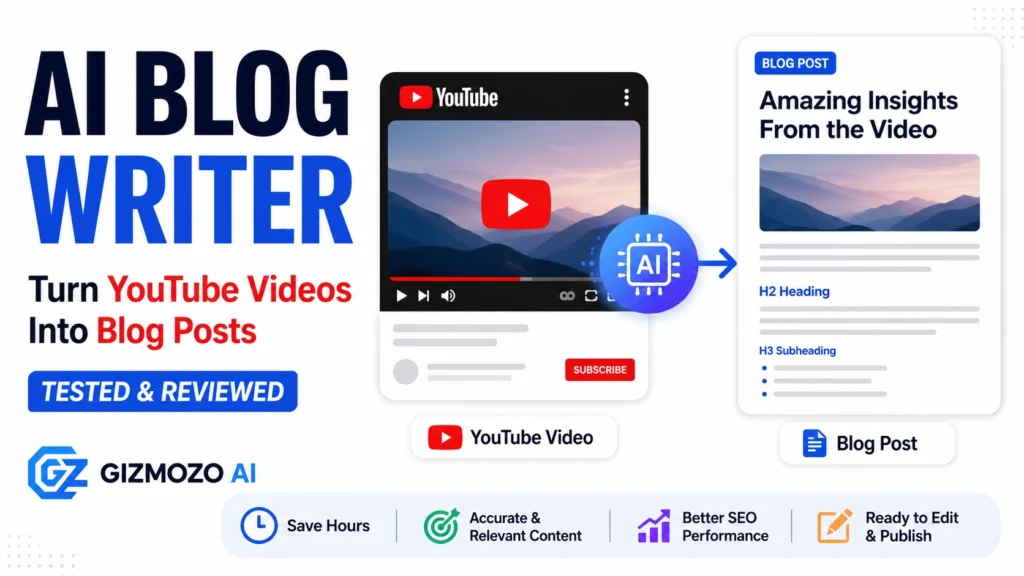
Yes, an AI blog writer can write a blog post from a YouTube video, but the quality depends entirely on how it creates the article. AI that invents information from a topic prompt often produces generic content. AI that starts with a YouTube transcript and restructures it into a well-written article typically produces more accurate, useful, and publishable results.
To see how practical this really is, I tested the workflow that many creators, marketers, and bloggers are beginning to adopt: taking a YouTube video and turning it into a complete blog article.
The results were better than I expected,, but only after I understood what AI should actually be doing.
Why More People Are Looking for an AI Blog Writer
Content creation has changed dramatically over the last few years.
Most businesses no longer struggle with finding ideas.
Instead, they struggle with turning those ideas into publishable content consistently.
If you already produce YouTube videos, podcasts, webinars, or interviews, you’ve already created the hard part.
The knowledge exists.
The challenge is converting that knowledge into written content without spending another three or four hours writing.
This is where an AI blog writer becomes valuable.
Instead of asking AI to invent an article from nothing, you’re asking it to transform information that already exists.
That difference is much bigger than most people realize.
The Problem With Generic AI Blog Writing
One mistake I see repeatedly is people opening a chatbot and typing:
Write me a 2,000-word blog post about digital marketing.
The AI usually produces something readable.
Unfortunately, it also sounds like thousands of other articles already online.
Why?
Because the AI has no unique source material.
It generates content from patterns it learned during training rather than from your own expertise.
That’s why so many AI-written blogs feel repetitive.
They’re technically correct.
They’re grammatically fine.
But they rarely contain anything memorable.
Why YouTube Videos Make Better Source Material
A YouTube video already contains something generic AI does not:
Original expertise.
Whether the video is:
- a product review
- a software tutorial
- a conference presentation
- an educational lecture
- an interview
- a podcast
…it already contains real explanations, opinions, examples, and experience.
Instead of asking AI to imagine what an expert might say…
…you’re asking it to organize what the expert actually said.
That produces much stronger content.
We Tested an AI Blog Writer Using a YouTube Video
For this test, I followed a workflow that mirrors how many modern content teams operate.
Step 1
Choose a detailed YouTube video.
Tutorials, reviews, interviews, and educational videos usually work best because they contain structured information.
Step 2
Extract the transcript.
The transcript becomes the source document.
Every fact in the final article should be traceable back to something discussed in the video.
Step 3
Generate the article.
Instead of copying the transcript, the AI reorganizes it into a proper blog structure.
That includes:
- Introduction
- Headings
- Logical flow
- Better readability
- Clear conclusions
Step 4
Review everything.
No matter how good AI becomes, a human review is still important.
I checked:
- factual accuracy
- formatting
- grammar
- missing context
- outdated information
The review took less than ten minutes.
Writing the article manually would probably have taken three or four hours.
What Surprised Me Most
I expected the biggest time saver to be the writing itself.
It wasn’t.
The biggest advantage was eliminating the blank page.
Anyone who writes regularly knows this feeling.
You know the topic.
You understand the audience.
But getting started feels slow.
AI removed that completely.
Instead of writing paragraph one…
I started editing paragraph one.
That small difference changes the entire workflow.
The Non-Obvious Insight Most People Miss
Most discussions about AI writing focus on speed.
I think that’s the wrong metric.
The real value is content extraction.
A thirty-minute YouTube video might contain:
- ten useful tips
- five examples
- several stories
- multiple statistics
- common mistakes
- personal opinions
Humans often overlook half of those while taking notes.
AI doesn’t.
It can analyze the entire transcript before deciding how to structure the article.
That’s a significant advantage.
Where AI Blog Writers Still Need Human Help
Despite impressive progress, AI still isn’t a replacement for editorial judgment.
There are several things I always review.
Personal experience
The AI only knows what appears in the source material.
If I’ve learned something after recording the video, I add it.
Updated information
Technology changes quickly.
A software tutorial from last year may already need updates.
Opinions
Readers want expertise.
Not just summaries.
I usually add:
- lessons learned
- practical recommendations
- things I would do differently today
These additions make the article uniquely mine.
SEO optimization
The AI usually creates a solid draft.
I still optimize:
- headings
- internal links
- title
- meta description
- keyword placement
These small improvements can significantly improve search performance.
What Makes a Good AI Blog Writer?
After testing several workflows, I think the best AI blog writers have four characteristics.
They use real source material
Instead of inventing content, they begin with:
- YouTube videos
- podcasts
- interviews
- transcripts
- webinars
They preserve meaning
Good AI rewrites.
It doesn’t distort.
The final article should communicate exactly what the original speaker intended.
They organize information
Spoken language isn’t written language.
Videos repeat ideas.
People pause.
They change direction.
A good AI reorganizes all of that into something readers enjoy.
They save editing time
If you spend an hour fixing the AI output…
…the workflow failed.
Good AI reduces editing not increases it.
How We Use Gizmozo AI
This is exactly the workflow we designed for Gizmozo AI.
Instead of asking users to write complicated prompts, the platform starts with the YouTube video itself.
The process is straightforward.
- Copy the YouTube URL.
- Paste it into Gizmozo.
- Choose your content type.
- Generate.
The transcript becomes the foundation.
From there, Gizmozo AI restructures the information into formats such as:
- Blog posts
- Product reviews
- Educational articles
- News articles
- Social media posts
Because the content originates from the video itself, the final article remains grounded in the creator’s own knowledge instead of generic AI writing.
Practical Checklist Before Publishing an AI-Written Blog
Before clicking Publish, I recommend checking these points.
✓ Is every factual claim supported?
✓ Does the introduction answer the reader’s question?
✓ Are headings descriptive?
✓ Did you add your own expertise?
✓ Are statistics still current?
✓ Did you include internal links?
✓ Does the article sound natural?
✓ Would you trust this article if someone else wrote it?
If the answer is yes to all of these, you’re in good shape.
The Future of AI Blog Writing
I don’t think AI will replace professional writers.
I think it will replace repetitive writing.
There’s a difference.
The best creators will still provide:
- ideas
- expertise
- opinions
- research
- creativity
AI will increasingly handle:
- drafting
- formatting
- restructuring
- summarizing
- repurposing
That’s a much healthier partnership than expecting AI to create expert knowledge from nothing.
FAQ
Yes. Modern AI blog writers can analyze YouTube transcripts and transform them into structured articles. The best results come from detailed source videos followed by a human editorial review.
It can be. Search engines evaluate helpfulness, originality, and usefulness rather than simply how content was produced. Well-edited AI-assisted articles based on real expertise can perform well in search.
A good AI blog writer should not simply copy a transcript. It reorganizes spoken language into a readable article while preserving the original meaning.
Absolutely. AI creates an excellent first draft, but adding your own experience, updating information, and checking accuracy makes the final article significantly stronger.
Final Thoughts
After testing this workflow, I don’t see AI blog writers as replacements for writers.
I see them as productivity tools.
When combined with high-quality source material like YouTube videos, they dramatically reduce the time required to publish useful content while allowing creators to focus on what matters most: sharing expertise and refining ideas.
If you’re already creating YouTube videos, there’s no reason to let that knowledge stay locked inside a video player.
With Gizmozo AI, you can turn a single YouTube video into a structured blog post, product review, educational article, or social media content in minutes.
Try Gizmozo AI today and see how quickly your existing videos can become your next published article.