
YouTube content repurposing is the practice of taking a single video and transforming it into additional content formats blog posts, news articles, educational guides, and social media posts so the same ideas, research, and expertise reach a wider audience across more channels. For any creator or publisher who is already producing video content, it is one of the most efficient content strategies available, because the hard work of creating the original content has already been done.
The question is not whether to repurpose. It is how to do it well.
What Is YouTube Content Repurposing?
YouTube content repurposing means extracting the substance of a video the ideas, the analysis, the information, the narrative and restructuring it into formats designed for different audiences and different contexts.
A 20-minute tutorial becomes a step-by-step blog post. An expert interview becomes a news article and an educational guide. A product review becomes a structured comparison piece and a set of social captions.
The key word is restructuring. Content repurposing is not transcription. It is not copying the same text into a different box. It means understanding what each format needs, how a reader consumes a blog post versus how a viewer watches a video, and adapting the substance accordingly.
A video can meander, build gradually, and rely on visuals to carry meaning. A blog post needs clear headings, logical flow, and content that makes sense without seeing anything. A social post needs a hook in the first line. A news article needs the most important information first. Each format is a different communication act, not just a different container.
Why Repurpose a YouTube Video Instead of Starting From Scratch?
The real advantage of YouTube content repurposing is not that it produces more content. It is that it extracts more value from work that has already been done.
When a video is created, significant effort goes into it before the camera rolls: research, planning, structuring the argument, gathering examples, testing ideas. All of that intellectual work lives in the finished video. Without repurposing, it reaches only the people who watch that specific video on that specific platform.
Repurposing changes that equation. The same research, the same expertise, the same original thinking now reaches the person who prefers reading over watching. The person searching Google for a written guide. The person scrolling LinkedIn during a lunch break. The student looking for an educational explanation. The news reader who wants a structured summary.
Beyond audience reach, there is a practical SEO benefit. A YouTube video is largely invisible to Google’s text-based index. A well-structured blog post based on the same content creates a searchable, indexable page that can rank for relevant keywords and drive organic traffic for months or years after the video was published.
The efficiency argument is straightforward: the research is done once, and the value is extracted many times.
How One YouTube Video Can Become Multiple Content Assets
Here is a practical example of what this looks like with a real content type.
Imagine a 25-minute YouTube video reviewing a new software tool covering features, pricing, use cases, and the reviewer’s honest assessment after several weeks of use.
That single video can become:
A long-form blog post: a structured review article covering everything in the video, optimised for the keyword “software tool name review,” formatted for readers who want to evaluate the product before buying. See YouTube to Blog Guide for how this conversion works in practice.
A news article if the software has just launched or updated: a short news-style piece covering the announcement, the key changes, and what it means for users. The inverted pyramid structure, most important information first, is completely different from the video’s conversational flow.
An educational article: a how-to guide explaining how to use the tool’s key features, written for someone who has already decided to buy it and wants to learn how to get started. See [How to Create Educational Content From YouTube Videos] for format details.
Social media posts: a hook-first caption pulling the single most shareable insight from the review, adapted for Facebook, Instagram, LinkedIn, and X. See [How to Turn YouTube Videos Into Social Media Posts] for platform-specific guidance.
A product comparison piece taking the review’s observations and expanding them into a comparison against competing tools, which serves a different search intent from the original review.
Each of these serves a different reader, answers a different question, and ranks for different keywords. Together, they extend the original video’s value across every channel where the target audience might be looking.
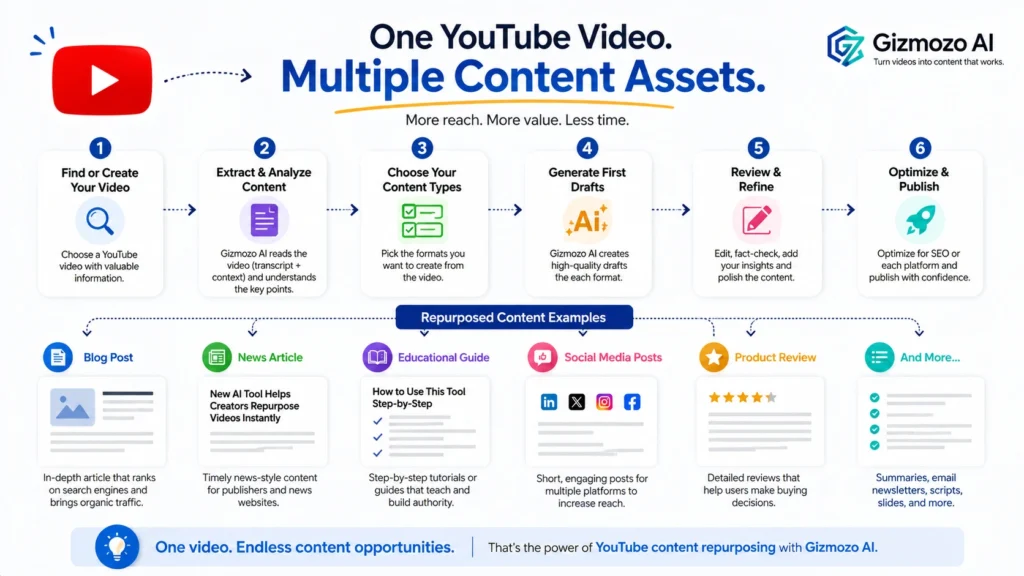
The YouTube Content Repurposing Workflow
A reliable content repurposing workflow follows eight stages:
1. Find or create the source video.
This can be your own video or a publicly available YouTube video covering a topic your audience cares about. The richer and more specific the content, the better the repurposed outputs will be.
2. Extract or analyse the video’s information.
For your own videos, you know the content. For third-party videos, watch enough of it to understand the key points, or use a tool that extracts the transcript automatically.
3. Decide which content formats are useful.
Not every video needs to become every format. A product announcement suits a news article. A tutorial suits an educational guide. An opinion piece suits a blog post and social content. Match the formats to the video’s nature.
4. Generate the first drafts.
This is where AI tools can reduce significant repetitive work. Transforming a transcript into a structured blog post, educational article, or social caption is the kind of mechanical transformation that AI handles well, provided the tool generates from the actual transcript content rather than from generic training data.
5. Review and fact-check.
Every AI-generated draft needs a human review pass. Check that specific claims, figures, names, and technical details are accurate. Add context that the source video may not have covered. Remove anything that does not hold up.
6. Optimise each format for its audience.
A blog post needs proper headings, a meta title, a meta description, and internal links. A social post needs a strong opening line and appropriate hashtags. A news article needs a strong lede. Do not skip this step; format-specific optimisation is what makes each piece genuinely useful to its intended audience.
7. Publish and distribute.
Publish each piece in the right place and promote it through the right channels. Link the blog post back to the original video. Share the social post at the right time for each platform.
8. Measure performance.
Track which formats drive the most traffic, engagement, and conversions. Over time, this tells you which video types and content formats are worth prioritising.
How AI Makes Content Repurposing Faster
AI reduces the repetitive transformation work at the centre of any repurposing workflow.
The transformation step taking a transcript and turning it into a structured blog post, or turning the same transcript into a differently structured news article is genuinely time-consuming when done manually. Reading the transcript, identifying the key ideas, reorganising them into a logical written structure, writing the prose, cleaning up the spoken language artifacts: for a 20-minute video, this process can easily take three to four hours per format.
AI handles that transformation in seconds. It identifies structure, removes speech artifacts, reorganises information into logical written flow, and generates prose adapted to the chosen format.
What AI does not replace is judgment. Deciding which formats to create, knowing what the audience actually needs, fact-checking specific claims, adding original perspective, adjusting the tone for a specific brand all of that still requires a human. AI is a production accelerator, not a publishing decision-maker.
The distinction matters practically. AI-generated content that goes straight to publication without review is a risk. AI-generated content that goes through a proper editorial process review, verification, and optimisation is efficient content production.
How Gizmozo AI Fits Into the Workflow
Gizmozo AI is built specifically for the YouTube-to-content transformation step.
You paste a YouTube URL. Gizmozo extracts the full transcript automatically and uses AI to transform it into a structured, publish-ready draft in one of four formats: blog post, news article, educational content, or social media post.
Each format uses a different prompt architecture designed for that specific output type. A blog post gets a proper introduction, logical section flow, and a conclusion. A news article gets an inverted pyramid structure with the most important information in the lede. An educational article builds concepts progressively for a learner. A social media post gets a hook-first structure designed for feed consumption.
The output is grounded in the actual transcript content, not in what a general AI model predicts the topic should say. This means the specificity of the source video carries through into the generated content, which produces more accurate and more original outputs than generic AI writing tools.
For a practical demonstration of how this works with a real example, see [YouTube Video to Article Generator].
Gizmozo does not replace the review, editing, and publishing steps. Those remain the creator’s responsibility. What it removes is the manual transcription and first-draft work that used to sit between watching a video and having something publishable.
A Real-World Example of YouTube Content Repurposing
Here is how this workflow runs in practice.
A technology reviewer publishes a detailed YouTube video covering a major smartphone software update, with 15 minutes of hands-on observations, feature breakdowns, and performance assessments. The video earns a solid audience on YouTube. But the people searching Google for coverage of the same update will not find the video in their results.
Pasting the video URL into Gizmozo and selecting Blog Post produces a structured article covering the update’s key features, what works, what does not, and a final verdict, all in the reviewer’s actual voice and with the reviewer’s specific observations preserved. The article needs a review pass to confirm technical accuracy and add any updated context, but the structure, the prose, and the substance are already there.
Selecting News Article from the same URL produces a shorter, more immediate piece leading with the most significant development from the update, suitable for a news-oriented site or a timely post while the story is current.
Selecting Social Media Post from the same URL produces a hook-first caption pulling the single most surprising finding from the review, ready to post across platforms with minimal editing.
Three different pieces. Three different formats. Three different audiences. One source video. One URL. A review pass for each. See [How to Turn a YouTube Video Into a Blog Post] for a detailed walkthrough of the blog post conversion specifically.
Best Practices for Repurposing YouTube Videos
Adapt the message, not just the format. Each repurposed piece should be written for its intended reader. A blog post reader is not a video viewer. A LinkedIn audience is not a YouTube subscriber. The core information can be the same; the presentation should not be.
Add original value. The best repurposed content adds something the source video did not cover: updated information, an additional example, the creator’s own perspective as someone who has used the product or researched the topic further. This is what separates genuinely useful content from mechanical reformatting.
Fact-check specific claims. Names, figures, dates, and technical details should be verified before publishing. A source video reviewer may have stated a specification incorrectly. A transcript may have captured a figure inaccurately. Do not publish what the AI generated without checking the facts.
Optimise each format properly. A blog post needs a meta title and meta description. A social post needs appropriate hashtags. A news article needs a strong lede. Format-specific optimisation is not optional it is what makes each piece work for its intended channel.
Review AI-generated content before publishing. Every piece generated by Gizmozo or any other AI tool should go through a proper editorial review. The AI handles the transformation. The creator handles the judgment.
Common Mistakes to Avoid
Publishing raw AI output. AI-generated content is a first draft. Publishing it without review risks factual errors, tonal inconsistencies, and content that does not reflect the creator’s standards.
Creating multiple versions with no meaningful difference. If the blog post, the news article, and the educational guide all say the same thing in essentially the same way, you have not repurposed; you have duplicated. Each format should genuinely serve its audience differently.
Ignoring search intent. A blog post about a software update serves a different search intent from a news article about the same update. Understanding what the reader is actually looking for and writing for that intent is what makes content rank and convert.
Forgetting the original video’s context. A transcript extracted from a video that relied heavily on visuals may contain references to things the viewer was shown, but the reader cannot see. These need to be removed or replaced with written descriptions.
Treating quantity as the main goal. Five pieces of mediocre repurposed content are less valuable than one genuinely useful piece. Repurposing is about extracting more value from existing work, not producing as much content as possible.
A Simple YouTube Content Repurposing Framework
Use this framework as a repeatable starting point:
Source: Identify a YouTube video with substantive content your audience would benefit from.
Select formats: Choose the content types that match the video’s nature and your audience’s needs. Not every video needs every format.
Generate drafts: Use Gizmozo AI to produce structured first drafts for each chosen format from the single source URL.
Review and adapt: check factual accuracy, add original perspective, adjust tone for the platform, and optimise for the intended audience.
Publish with purpose: each piece should have a clear home, a proper meta setup, and a distribution plan appropriate to its format.
Evaluate and track which formats perform best for which video types. Let the data inform future repurposing decisions.
Frequently Asked Questions
What is YouTube content repurposing?
YouTube content repurposing is the process of transforming a YouTube video into additional content formats such as blog posts, news articles, educational guides, and social media posts so the same information reaches wider audiences across more channels. It is more efficient than creating every piece of content from scratch because the research and ideas in the original video already represent significant creative and intellectual effort.
How can I turn a YouTube video into a blog post?
The most practical approach in 2026 is to use a tool that extracts the video transcript automatically and transforms it into a structured article. Gizmozo AI does this from a single YouTube URL, producing a blog post with a proper introduction, section headings, and conclusion in under 60 seconds. The output should be reviewed, edited for accuracy, and optimised for the target keyword before publishing. See [How to Turn a YouTube Video Into a Blog Post] for a complete walkthrough.
Can AI repurpose YouTube videos into different content formats?
Yes, AI tools can transform a YouTube transcript into multiple content formats, each with a different structure suited to its purpose. Gizmozo AI supports blog posts, news articles, educational content, and social media posts from a single URL. The key quality factor is whether the tool generates from the actual transcript content or from general AI training data. Transcript-grounded generation produces more accurate and more specific output.
Is AI-generated repurposed content ready to publish?
Not without review. AI-generated content is a well-structured first draft, not a finished piece. Every generated article should be checked for factual accuracy, adapted with original perspective where useful, optimised for the target audience and platform, and reviewed against the creator’s editorial standards before publishing. AI handles the repetitive transformation work. The creator remains responsible for the quality and accuracy of the final published content.
Get More From Every YouTube Video
YouTube content repurposing is not a content hack. It is a logical extension of the work that has already been done. The research, the expertise, the production effort, the ideas that went into creating a video all of that value is currently reaching only the people who watch that video. Repurposing gets it to everyone else.
The workflow is straightforward: find the source, select the right formats, generate structured first drafts, review and adapt each one for its audience, and publish with purpose. AI tools like Gizmozo reduce the most time-consuming part of that workflow: the manual transformation from transcript to structured content without removing the editorial judgment that determines whether the final piece is actually worth publishing.
If you want to see what this looks like in practice with your own content, try Gizmozo AI for free at gizmozo.com. Paste any YouTube URL and have a structured first draft in any of the four formats in under 60 seconds. The review is yours. The production work is handled.