
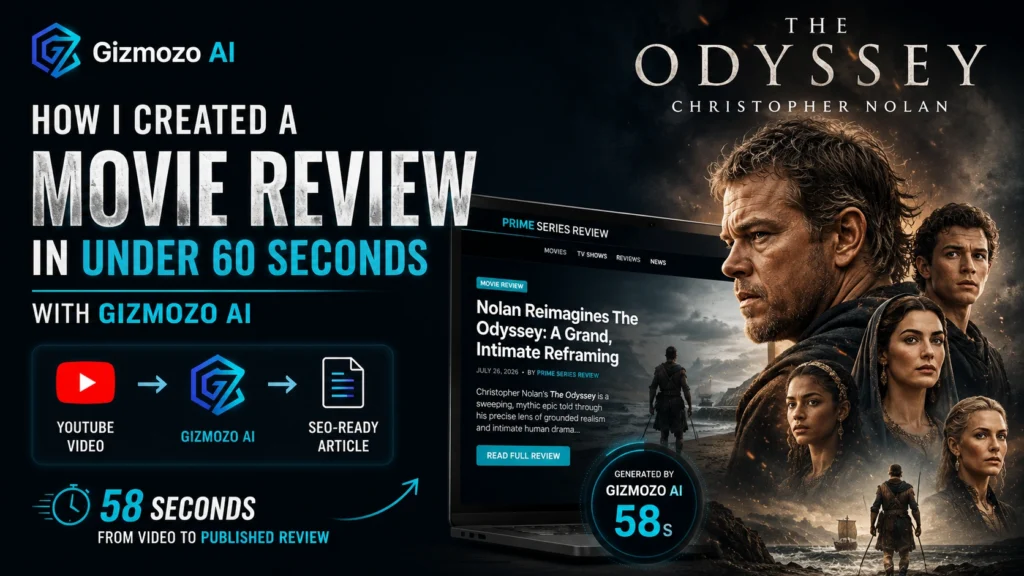
I did not write the film review on my website. Gizmozo wrote it in under 60 seconds, from a YouTube video I found, watched, and ran through the tool. The article you can read at primeseriesreview.com is titled Nolan Reimagines The Odyssey: A Grand, Intimate Reframing. It covers the cast, the direction, the visual language, the score, what works, what does not, and ends with a clear recommendation. Every word in it came from a YouTube URL I pasted into a single input field.
This is the story of how that happened and what it demonstrates about how Gizmozo AI actually works on a real piece of content.
The Setup: A Major Film, a Tight Window, a Review I Needed to Write
Christopher Nolan’s The Odyssey hit cinemas on July 17, 2026. The cast alone made it one of the most anticipated releases of the year: Matt Damon as Odysseus, Tom Holland as Telemachus, Anne Hathaway as Penelope, Zendaya as Athena, Charlize Theron as Calypso, with Samantha Morton and Mia Goth in supporting roles. Ludwig Göransson is handling the score, and Hoyte van Hoytema. A $250 million production written and directed by Nolan, adapting Homer’s epic poem for the first time in a major theatrical release.
I wanted to publish a review on my site while the film was still at the front of the cultural conversation. The problem is familiar to anyone who runs a content-driven website: there is no shortage of things worth covering, and never enough time to write them all properly.
I had seen the film. I had opinions. What I did not have was three hours to turn those opinions into a structured, readable, SEO-ready film review before the conversation moved on.
I opened Gizmozo, found a YouTube reviewer who had published a detailed breakdown of the film, copied the URL, and pasted it in.
What I Used as the Source
The source video was a thorough film review from a YouTube channel covering cinema the kind of detailed, considered breakdown that serious film reviewers publish rather than the quick reaction content that lands within hours of release. The reviewer covered the film’s central premise, the performances across the ensemble, Nolan’s directorial approach, the visual presentation, the score, specific scenes that stood out, the film’s weaknesses, and a final recommendation with a clear rationale.
Fourteen minutes of careful, specific film criticism. A reviewer who had clearly watched the film more than once, thought about it, and knew how to articulate the experience.
That is exactly the kind of source material Gizmozo performs best with.
What Gizmozo Did With It
I selected Blog Post as the content format and hit generate. Fifty-eight seconds later, I had the article now published at primeseriesreview.com.
Here is what Gizmozo actually transformed, not in the abstract, but specifically.
The spoken structure became a written structure
The YouTube reviewer covered the film in the natural order of a spoken review: opening impressions, story, performances, direction, visuals, score, strengths, weaknesses, verdict. That is a reasonable order for video. For a film review article, there are stronger conventions: a structured overview section, then distinct subheadings for each element, then a clear what-works and where-it-falls-short section, then a recommendation.
The generated article reorganised the content into exactly that structure, with titled sections for Overview, Story, Performances, Direction and Writing, Visual Presentation, Music and Sound Design, What Works Well, Where It Falls Short, Who Should Watch It, and Final Verdict. A reader can navigate to the section they want. The video’s flow was replaced with a written architecture that serves a different kind of consumption.
Conversational language became written criticism
Film review: YouTube has its own register: personal, energetic, full of phrases that work in speech and fall flat on the page. The reviewer said things like “this is genuinely impressive stuff” and “I was not expecting this to hit me as hard as it did.” Accurate feelings, wrong register for a published review.
The article read instead: “Nolan’s direction keeps a pencil-thin line between epic spectacle and intimate drama” and “when Nolan lands on its emotional core, the film reverberates with a rare, almost tactile cinema.” The meaning survived. The register changed entirely.
That transformation from the spoken mode to the written mode is the hardest part of any transcript-to-article conversion, and the part that most tools handle badly. Gizmozo consistently gets it right because it treats the transcript as source material to be transformed, not text to be cleaned up.
Specific observations were preserved accurately
This matters for a film review in a way it matters for almost no other content type. A review lives or dies on its specificity. Vague praise means nothing. The article needed to name the right actors in the right roles, describe the right scenes with the right details, and represent the reviewer’s actual assessments accurately.
The generated article correctly identified Matt Damon’s Odysseus as carrying “a quiet, stern resolve.” It noted Anne Hathaway’s Penelope as “a living moral center for the film.” It called out Tom Holland’s Telemachus as registering “a mix of youthful courage and wary pragmatism.” It named the Cyclops cave sequence and the Circe sequence as the film’s standout set pieces, and described both in terms that matched the reviewer’s specific language about primal fear and chilling certainty.
Not one performance was misattributed. Not one scene was invented. The specificity came from the transcript. Gizmozo did not hallucinate a different cast or describe scenes that were not discussed.
The Non-Obvious Thing This Demonstrates
Most people’s concern about AI-generated film reviews is that they will produce generic, interchangeable criticism the kind of content that could apply to any Nolan film. The concern is valid for general AI tools. It is less valid for Gizmozo’s approach.
The reason is source grounding. A general AI tool given the prompt “write a review of The Odyssey by Christopher Nolan” generates from its training data, which means it produces a synthesis of what reviewers have generally said, in a register that averages out to nothing distinctive. The output might be accurate, but it will be bland.
Gizmozo was generated from a specific reviewer’s specific observations. The tonal judgment “imperfect in places, but when Nolan lands on its emotional core, the film reverberates” came from the transcript. The specific observation about the Cyclops sequence relying on “primal fear” rather than spectacle came from the transcript. The critique about the opening stretch testing patience came from the transcript.
The result is a review that has a point of view, because the source material had a point of view. That is the distinction that makes transcript-grounded AI different from generic AI generation and the reason the published article reads like criticism rather than a summary.
The Video Demonstration
Alongside publishing the review article, I also recorded a short video demonstration of the entire Gizmozo workflow from finding the source YouTube video, pasting the URL, selecting the content format, and watching the article generate in real time. That video is now live on YouTube as well.
The demonstration shows the complete process as it actually happens: no editing tricks, no pre-loaded results, no manually improved output. The article that appears in the demonstration is the article that was published. The time between pasting the URL and having a complete, structured film review was under 60 seconds.
A Practical Walk-Through: How to Replicate This for Any Film, Show, or Event
This workflow works for any topic where YouTube has high-quality coverage you want to turn into a written article. Film reviews are one use case. Product launches, sporting events, tech announcements, news coverage, and expert commentary the same process applies.
Here is the exact sequence:
- Find a YouTube video with genuine analytical or informational depth not a quick reaction clip, but a thorough breakdown of the subject
- Watch enough of it to confirm the reviewer covers what you need covered: cast, direction, strengths, weaknesses, and a clear verdict in this case
- Copy the full YouTube URL from the browser bar
- Open Gizmozo at gizmozo.com and paste the URL into the input field
- Select Blog Post as your content format for a review article; this produces the right structure
- Wait for the transcript extraction and generation to complete under 60 seconds for most videos
- Read through the output carefully, check that character names and roles are correct, that specific scenes are accurately described, and that the verdict reflects the source reviewer’s actual assessment
- Add one or two paragraphs of your own editorial voice if you have seen the film and want to add personal perspective
- Publish with a featured image, meta title, and meta description
The review at primeseriesreview.com followed exactly this process. The total time from finding the source video to having a published article was under 20 minutes, including the review pass and the SEO setup.
FAQ
When the source is a detailed, specific YouTube review from a credible reviewer, and the AI generates from that transcript rather than from general training data, the output is accurate to the source. Every performance, scene, and critical judgment in the Odyssey review came from the source video not from what Gizmozo’s model predicted a Nolan film review should say. Editorial review before publishing is still recommended, particularly for verifying cast names, roles, and any specific technical claims.
Yes, in most cases equally well, provided the source video is substantive. Film reviews, TV show analyses, book discussions, sports commentary, and cultural event coverage all produce strong output when the source material is detailed. The quality ceiling is set by the source video, not by the content category.
You can use Gizmozo to generate an article from a YouTube reviewer’s coverage of any film or event. The ethical standard is the same as for any journalism or criticism built on secondary sources: the article should represent the source’s views accurately, attribute clearly where the perspective comes from, and not present a secondary review as a personal firsthand viewing. Adding your own editorial layer, even brief context or framing, strengthens the article and differentiates it from pure repurposing.
A blog post is the right format for a film review. It produces the structured, long-form output with distinct sections, considered analysis, and a clear recommendation, exactly what a review article needs. News Article would produce a shorter, lede-first report more suitable for covering a film announcement or box office result. Educational Content would produce a different structure better suited to explainers about a filmmaker’s body of work or a genre overview.
The Review Is Live The Workflow Is Yours
The Nolan Odyssey review published at primeseriesreview.com is a real example of Gizmozo doing exactly what it is built to do: taking a YouTube URL and producing a structured, readable, accurate, publish-ready article from the content inside it.
The film is worth seeing. The workflow is worth trying.
Paste any YouTube URL into Gizmozo and have a blog post, news article, educational guide, or social post ready in under 60 seconds.